Elhokar Kholin
The Way of KingsElhokar Kholin is the heir and king of Alethkar, a ruler whose formal authority exceeds his experience and whose position exposes the instability of the kingdom he inherits. He presides over a court shaped by rank, ceremony, military rivalry, and competing ideas of duty, while his uncle Dalinar Kholin increasingly attempts to turn the divided war effort into a coherent national enterprise. Elhokar’s significance lies in that struggle: he is not merely a sovereign surrounded by danger, but the vulnerable center around which questions of legitimacy, loyalty, and state-building gather.
Identity and Introduction
Elhokar first appears as the king’s son and heir at a feast held after the treaty with the Parshendi. While his father has retired, Elhokar sits at the high table and effectively rules the feast in his absence. His position is unmistakable, yet the scene places him amid uncertainty: Dalinar is incapacitated by drink, Jasnah Kholin is absent, and Elhokar is speaking with companions whose identities matter less than the fact that he is already performing kingship before the gathered elite.
That performance is surrounded by signs that the political order is less secure than its ceremony suggests. The Parshendi musicians are treated as outsiders, even as wine allows Alethi lighteyes to abandon their customary disdain for drums. The Parshendi are preparing to withdraw and break a treaty made only hours earlier, but Elhokar’s feast continues in apparent celebration. His kingship therefore enters the narrative at the intersection of spectacle and impending rupture: the court can maintain its rituals even when the agreement underlying them is already collapsing.
Kingship and Conduct
Elhokar’s public manner combines royal confidence with reckless competitiveness. While riding across the Shattered Plains, he announces that the day is an excellent one to slay a god, a boast that Sadeas answers with smooth approval. Soon afterward, Elhokar challenges Dalinar to race to the top of a rock formation, wagering five full broams and galloping away before his uncle can respond. The gesture is playful on its surface, but it forces Dalinar to abandon caution and order Adolin Kholin to secure the next plateau while he pursues the king.
The episode reveals a ruler who treats danger as an arena for personal display. Elhokar’s authority permits him to turn a military movement into a contest, while those around him must absorb the practical consequences. His bravado is not matched by control over the larger political situation. The contrast between his flamboyant declarations and the vulnerability of the armies he commands makes his kingship unstable: he can speak like a conquering monarch, but he relies on older and more capable figures to prevent his impulses from becoming disasters.
Dependence on Dalinar Kholin
Dalinar is both Elhokar’s uncle and the force most intent on preserving the kingdom behind the king’s authority. Their relationship becomes especially strained when Dalinar admits that, if he possessed the power to do so, he would bring all ten warcamps back to Alethkar. Elhokar is shocked by the statement, interpreting withdrawal through the language of cowardice, while Dalinar insists that he has confronted cowardice within himself and recognizes this desire as something different.
Dalinar’s political vision also begins from Elhokar’s throne. Remembering the command to unite them, Dalinar asks whether Elhokar recalls the earlier proposal to specialize the ten highprinces. The system had once been intended to make the highprinces cooperate by assigning them distinct responsibilities, but the fragmentation of Alethkar into ten autonomous princedoms had long since weakened that arrangement. Elhokar confirms the history, allowing Dalinar to connect an old governmental idea with a new plan for wartime unity.
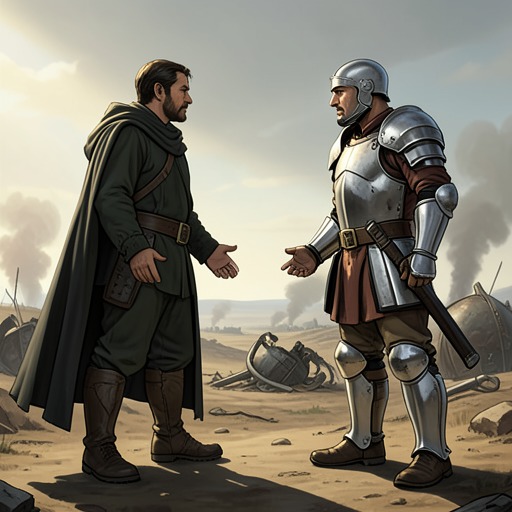
By the end of the supplied arc, Dalinar’s relationship with Elhokar has become coercive as well as protective. Dalinar enters the king’s palace sitting room, where guards loyal to Dalinar bar anyone from interfering. He physically overpowers Elhokar, repeatedly prevents him from summoning or retaining his Shardblade, and explains that the guards will not answer even the king’s pleas for help because they are Dalinar’s men. The scene reverses the expected hierarchy: the king wears Shardplate, but the supposedly subordinate uncle controls the room, the guards, and the immediate terms of political discussion.
Political Reorganization
Dalinar does not intend to punish Sadeas merely for betraying him. He tells Elhokar that Sadeas is neither worse nor better than the other highprinces and argues that any of them would betray their fellows if they could do so without personal risk. Elhokar is therefore confronted with a structural diagnosis rather than a single enemy. The problem is not only Sadeas’s character; it is a political system that rewards rivalry while allowing its leaders to preserve the appearance of honor.
Dalinar proposes to become Highprince of War and enforce the Codes across all ten camps. He plans to coordinate plateau assaults directly, determine which armies attack which plateaus, place all gemhearts won under the authority of the Throne, and distribute them as spoils through the king. His stated aim is to transform ten competing armies and their leaders into an actual military force. Elhokar immediately recognizes the danger to his own reign, warning that the highprinces may revolt and that he may not last a week. His reaction captures the cost of centralization: the reform that could strengthen the kingdom could also expose the king to the united hostility of the nobles he nominally commands.
Elhokar’s role in this plan is therefore paradoxical. He is the source of legitimacy for Dalinar’s office and the institution through which military resources would be centralized, but he lacks the confidence to impose that transformation himself. Dalinar must seize the initiative, using the king’s seal and the prospect of appointment to create a stronger monarchy than Elhokar appears ready to exercise. The arrangement preserves Elhokar’s throne while narrowing his immediate freedom, making him both beneficiary and potential casualty of reform.
Vulnerability and Narrative Function
Elhokar’s vulnerability is emphasized through the way others speak around him and through the physical reversals he suffers. At the feast he is the heir governing in his father’s absence; on the Shattered Plains he is the king who races ahead of his escort; in the palace he is a fully armored sovereign reduced to one knee while calling for guards who have been ordered not to come. These moments do not erase his authority, but they expose how dependent that authority is on institutions, relatives, and loyal retainers.
His position also links private anxiety to public crisis. Rumors about Dalinar and Navani Kholin trouble him enough to raise the subject directly, even while the kingdom faces military and political threats. The concern shows a king attentive to the judgments of others, and it helps explain why personal reputation, noble honor, and public appearance remain so powerful in his decisions. Elhokar governs in a world where the appearance of propriety can matter almost as much as effective action, yet the war increasingly demands choices that disrupt established appearances.
Elhokar consequently functions as a measure of the gap between inherited kingship and earned leadership. He possesses the title, the colors, and the symbols of rule, but the people around him repeatedly reveal the limits of symbolic power. His story is not one of simple incompetence; it is the story of a young monarch forced to confront a realm whose institutions have decayed, whose highprinces compete instead of cooperate, and whose strongest political actor must take extraordinary measures to keep the crown from becoming irrelevant.